The five project measures of “B5 – advising, educating, engaging, accompanying, caring”.
Press release
Fördergesellschaft Kultur und Integration gGmbH and its cooperation partners are receiving €1,945,378.45 in AMIF funding to implement the project “B5 – beraten, bilden, bewegen, begleiten, betreuen”. The project partners are contributing a total of €216,153.17 of their own funds. The overall cost of project B5 is €2,161,531.62. Funding from the European Union’s Asylum, Migration and Integration Fund (AMIF) runs from 1 March 2025 for a period of three years.
These funds enable Fördergesellschaft Kultur und Integration gGmbH, TVG Holsterhausen, RAA Verein NRW e. V., KD11-13 GmbH and Interkulturelle Assistenz e. V. to carry out measures that increase equal opportunity and the integration of third-country nationals in exchange with the receiving society. The project supports European goals for legal migration and for the integration of migrants into the receiving society, and creates additional services that people from third countries can use. This opens up more opportunities for social participation and more spaces for encounter and exchange.
The project “B5 – advising, educating, engaging, accompanying, caring” takes a holistic approach: its five measures embed third-country nationals in a diverse network in which exchange between them and the host society is actively initiated and encouraged.
The five project measures
1
Empowerment work for women who are third-country nationals
Project partner: Fördergesellschaft Kultur und Integration gGmbH
The measure helps women who are third-country nationals to integrate into society more quickly, build social networks and better understand their own rights. Women meet weekly in small groups of 6 to 12 participants – with childcare provided – and exchange views on health, education, politics, parenting, leisure and everyday life in Germany. Networking with the host society is a key aspect: external speakers are invited to share knowledge about politics, social structures and healthcare.
2
Integration through sport for third-country nationals
Regular, free sport and exercise activities strengthen the social participation of third-country nationals and enable encounters with the host society. Shared activities such as swimming, basketball, judo or holiday camps for children and young people create opportunities for intercultural understanding and for breaking down barriers. Participants not only improve their physical health but also make new social contacts and gain insight into how clubs work. The aim is to convey the joy of movement, make leisure activities easier to access and contribute to successful everyday integration.
3a
Referral counselling point in CityNord
Project partner: RAA Verein NRW e. V., Essener CityNord
Many third-country nationals still find it difficult to navigate life in the city of Essen and need support in approaching the right institutions and services. The referral counselling point helps with orientation and advises on everyday questions. It offers individual, multilingual orientation counselling to make integration easier. For more in-depth matters, people are referred specifically to the mainstream services. The service is multilingual, so language barriers are not an obstacle.
3b
Referral counselling point in Altenessen
Project partner: KD11/13 GmbH, Essen-Altenessen
Like the point in CityNord, this counselling point helps third-country nationals find their way in the city of Essen and identify the right institutions and services. It advises on everyday questions and offers individual, multilingual orientation counselling. For more in-depth matters people are referred to the mainstream services, so that language barriers are not an obstacle.
4
Inclusion work for third-country nationals in Essen CityNord
Project partner: Interkulturelle Assistenz e. V., Essener CityNord
Many people with disabilities face major challenges when navigating complex bureaucracy and online search portals. Administrative processes are often hard to understand and digital information is confusing or not accessible. This makes it harder to reach important benefits, rights and support services.
The inclusion work and counselling of Interkulturelle Assistenz helps people with disabilities from third countries to find their way through digital and bureaucratic structures. It provides targeted support in finding relevant information online, filling in applications and dealing with public authorities.
Individual, multilingual counselling is also offered in order to remove digital barriers and make important services easier to reach. More complex matters are referred to specialised counselling centres and services. The service is designed to be accessible, so that neither language barriers nor digital or bureaucratic hurdles limit participation.
From the project partners’ point of view this funding is extraordinarily important for gradually expanding social participation and exchange with the receiving society. We are delighted about this funding, which will benefit third-country nationals in Essen and the surrounding area as well as the city community of Essen. For three years the project partners can test and further develop the measures.
Ruzica Tadic-RuzicProject lead at Fördergesellschaft Kultur und Integration gGmbH
With this project the partners want to contribute to the successful implementation of legal migration of third-country nationals and their integration, and to further enrich the exchange between third-country nationals and the receiving society.
Tuncer KalayciManaging director of Fördergesellschaft Kultur und Integration gGmbH
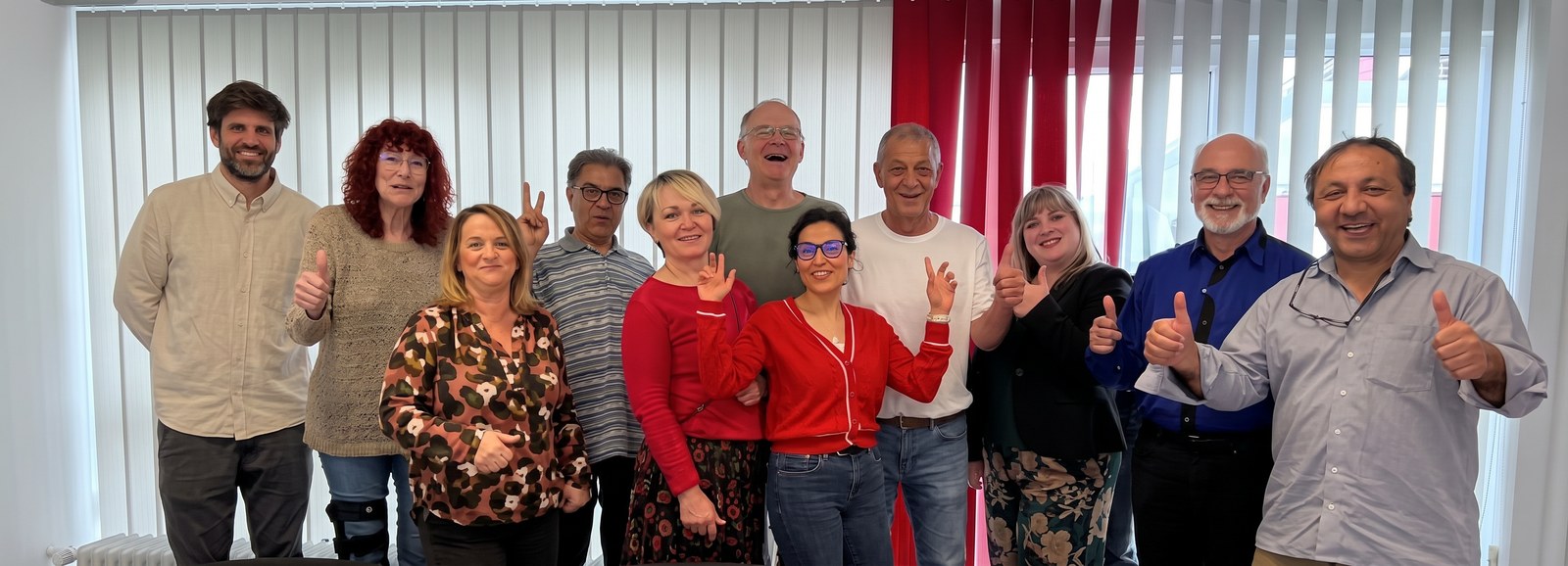
Group photo with project and network partnersFoto: Fördergesellschaft Kultur und Integration gGmbH
Working together in a network
Each of the cooperating project partners looks back on a long tradition of integration and empowerment work. In this project they pool their experience and expertise. The City of Essen’s Office for Housing and Social Affairs participates as a network partner and regularly supports the project.
About AMIF and the funding volume
The Asylum, Migration and Integration Fund (AMIF) is a financing instrument of the European Union that supports EU member states in implementing European asylum, migration and integration policy. In Germany the Federal Office for Migration and Refugees (BAMF) administers the AMIF 2021–2027 funds on behalf of the Federal Ministry of the Interior (BMI).
Total funding volume
For all EU member states, around €10 billion is available in the 2021–2027 funding period. Germany’s share is around €1.5 billion for project funding plus €500 million for special measures under the thematic facility – for example resettlement, humanitarian admission and the relocation of people in need of protection from one member state to another.
About Fördergesellschaft Kultur und Integration gGmbH
Fördergesellschaft organises and runs the following services, among others:
Working in schools in Essen
Language companions in schools in Essen
Provider of the Federal Volunteer Service – supporting disability work and events by children for children
Training company for office management
Cooperation with Dortmund University of Applied Sciences with two dual study places in social work, specialising in migration, integration and displacement
Organising and running cultural events as a provider
Close networking within the city of Essen with municipal departments, associations, federations and migrant organisations
Another focus is the deployment of language and integration mediators in the “SprInt Vermittlungsservice Essen” department. Language and integration mediators (SprInt) act as intermediaries between people with a migration background and mainstream services. Their core tasks:
Specialist interpreting
Conveying socio-cultural knowledge – for example culture-specific rules, dealing with illness, gender roles, taboos and shame
Recognising misunderstandings and intervening appropriately
Assisting social work professionals
Fördergesellschaft currently employs around 270 intercultural language and integration mediators working in some 64 languages and dialects. They work, amongst other places, within the City of Essen’s regular services – such as the Youth Welfare Office, Public Health Department, JobCentre, nursery schools and schools – as well as in hospitals, psychiatric clinics and at charitable organisations.